
Our core programs & activities
BLACOMO ADVOCACY NETWORK offers a range of specialized programs designed to empower youth, support families, and engage community leaders. Our approach is focused on understanding and responding to real-world needs, providing effective and practical solutions that foster growth and resilience.

Community awareness & non-violence
We facilitate crucial community awareness campaigns on non-violence and address drug use and misuse. These initiatives are vital for educating and empowering youth, families, and community leaders to create safer, more informed environments.
PEACE AMBASSADOR TRAINING MANUAL
Strength No To Violence
Youth Non‑Violence & Leadership Program – Sierra Leone:
PURPOSE OF THIS MANUAL:
This manual is designed to train Peace Ambassadors—young leaders who promote nonviolence, peaceful conflict resolution, emotional regulation, and positive leadership in their schools and communities across Sierra Leone.
It provides practical tools, activities, and guidance that can be used by facilitators, youth leaders, NGOs, schools, and community groups.
WHO IS A PEACE AMBASSADOR?
A Peace Ambassador is a young person who:
- Chooses non‑violence in words and actions
- Helps calm conflict instead of escalating it
- Leads by example
- Supports peers through listening and guidance
- Promotes peace, respect, and responsibility
Peace Ambassadors are not police and not enforcers. They are role models, listeners, and bridge‑builders.
CORE VALUES
- Respect
- Non‑violence
- Responsibility
- Self‑control
- Empathy
- Integrity
- Community service
TRAINING STRUCTURE
Duration: 3–5 days (flexible)
Modules:
- Understanding Violence & Peace
- Self‑Awareness & Emotional Control
- Communication & Listening Skills
- Conflict Resolution & De-escalation
- Leadership & Positive Influence
- Trauma, Stress & Substance Use Awareness
- Community Outreach & Peer Support
- Ethics, Safety & Boundaries
MODULE 1: UNDERSTANDING VIOLENCE & PEACE
Learning Objectives
Participants will:
- Understand different forms of violence
- Recognize causes of youth violence
- Understand peace as an active choice
Key Topics
- Physical violence
- Verbal and emotional violence
- Group and gang violence
- Political and community violence
- Impact of violence on future opportunities
Activity: “Cost of Violence”
Participants list what violence can cost them (life, freedom, school, family, respect).
Key Message
Strength nor to violence. Real power na self‑control.
MODULE 2: SELF‑AWARENESS & EMOTIONAL CONTROL
Learning Objectives
- Understand emotions (anger, fear, frustration)
- Learn healthy ways to manage emotions
Key Topics
- Triggers
- Body signs of anger
- Stress and frustration
Skills Taught
- Pause & breathe
- Walk away
- Grounding techniques
- Counting, hydration, and cooling down
Activity: “Know Your Trigger”
Youth identify personal triggers and safe responses.
MODULE 3: COMMUNICATION & LISTENING SKILLS
Learning Objectives
- Learn how to speak without fighting
- Practice active listening
Skills Taught
- Respectful language
- “I feel” statements
- Listening without interrupting
- Tone and body language
Activity: Role Play
Practice responding to insults without violence.
MODULE 4: CONFLICT RESOLUTION & DE‑ESCALATION
Learning Objectives
- Learn how conflicts grow
- Practice calming tense situations
De‑Escalation Steps
- Stay calm
- Lower your voice
- Create space
- Do not insult or threaten
- Suggest a pause
What NOT To Do
- Do not shout
- Do not shame
- Do not take sides aggressively
MODULE 5: LEADERSHIP & POSITIVE INFLUENCE
Learning Objectives
- Understand leadership as service
- Learn how influence works
Topics
- Being a role model
- Peer pressure
- Standing firm in values
Activity: “Leader I Admire”
Youth share qualities of leaders they respect.
MODULE 6: TRAUMA, STRESS & SUBSTANCE USE AWARENESS
Learning Objectives
- Understand how trauma affects behaviour
- Understand the link between substance use and violence
Key Topics
- Trauma responses
- Stress overload
- Drugs, alcohol, kush and aggression
Important Message
Hurt people sometimes hurt others—but healing is possible.
MODULE 7: COMMUNITY OUTREACH & PEER SUPPORT
Roles of a Peace Ambassador
- Listen
- Encourage peaceful choices
- Refer peers to support
- Promote peace activities
What Peace Ambassadors CAN Do
- Talk to peers
- Support mediation
- Organize peace events
What They CANNOT Do
- Fight
- Carry weapons
- Replace police or elders
MODULE 8: ETHICS, SAFETY & BOUNDARIES
Safety Rules
- Do not intervene in violent fights
- Seek adult or community support
- Protect your own safety first
Ethics
- Confidentiality
- Respect
- No gossip
- No favouritism
OATH OF A PEACE AMBASSADOR
“I choose peace over violence. I will lead with respect. I will control my actions. I will support others without judgment. I will protect my future and my community.”
MONITORING & SUPPORT
- Regular check‑ins with facilitators
- Monthly peer meetings
- Refresher trainings
- Recognition of ambassadors
SUGGESTED PEACE ACTIVITIES
- Peace talks in schools
- Football for Peace
- Community clean-ups
- Drama and spoken‑word events
- Peer dialogue circles
CONCLUSION
Peace Ambassadors are not perfect—they are committed. By choosing non‑violence, they protect their future and help build a safer Sierra Leone.
Peace na power. Strength nor to violence.
I’ve created a full Peace Ambassador Training Manual for you to use.
It’s structured, practical, and ready to use for schools, NGOs, youth clubs, and community programs in Sierra Leone.
What you now have
- A clear training framework (3–5 days)
- 8 complete modules with objectives, activities, and key messages
- Youth-friendly language and culturally grounded values
- Strong focus on non-violence, leadership, trauma awareness, and safety
- A Peace Ambassador Oath and suggested community activities
How you can use it
- Train Peace Ambassadors in schools and communities
- Attach it to donor proposals as a concrete deliverable
- Adapt modules for one-day workshops or radio discussions
- Translate sections into Krio for grassroots delivery
Top of Form
Bottom of Form

Health, well-being & sports engagement
Through sports and fitness activities, we promote physical and mental well-being. Our programs also include harm-reduction and relapse prevention strategies, offering vital support to individuals and families on their journey to recovery.
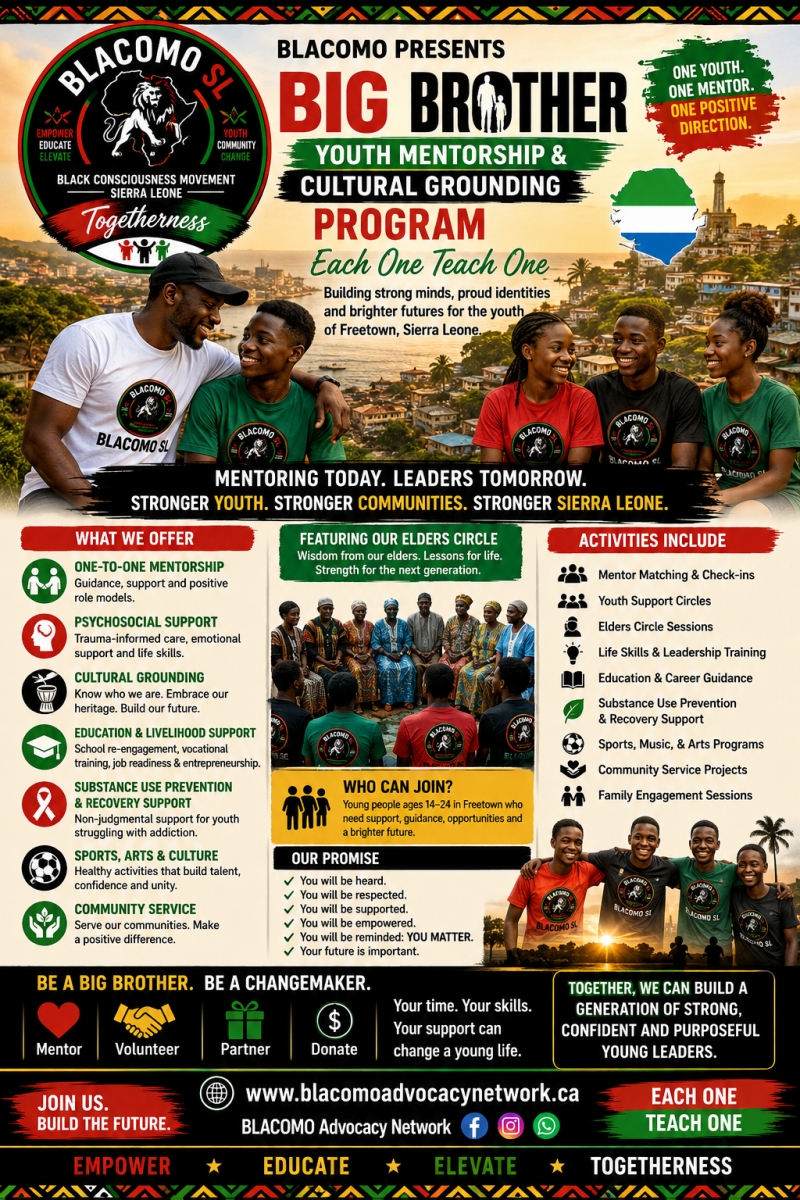
BLACOMO PRESENT BIG BROTHER YOUTH MENTORSHIP AND CULTURAL GROUNDING PROGRAM. Each One Teach One.
- Executive Summary
Young people in Freetown are growing up within a challenging social and economic environment. Poverty, unemployment, family instability, school disengagement, exposure to violence, substance use, community trauma, stigma, and limited access to psychosocial services can leave many young people without consistent positive guidance.
The BLACOMO Each One Teach One Youth Mentorship & Cultural Grounding Program proposes a community-based response built around one of the most important protective factors in a young person's life: a trustworthy, caring adult or mentor who consistently believes in them and helps them navigate challenges.
The program will connect approximately 100 young people with trained mentors, psychosocial support workers, cultural educators, community elders, and positive peer networks.
Rather than focusing only on problems, the program will build upon young people's strengths, cultural identity, aspirations, talents, relationships, and capacity to contribute positively to society.
A defining feature will be the BLACOMO Elders Circle, where respected community elders, cultural practitioners, educators, women leaders, and positive role models will help young people understand Sierra Leonean and African history, community responsibility, cultural values, identity, dignity, respect, and intergenerational wisdom.
The program will combine:
- One-to-one mentoring
- Group mentorship
- Psychosocial support
- Trauma-informed care
- Cultural grounding
- Elders Circles
- Education support
- Career development
- Substance-use prevention and recovery support
- Conflict-resolution skills
- Leadership development
- Sports, arts, music and cultural activities
- Family engagement
- Community service
- Peer leadership
The long-term vision is to develop young people who eventually become mentors, leaders and positive role models for the next generation.
- Background and Problem Statement
Sierra Leone's young population represents one of the country's greatest resources.
At the same time, many young people experience significant barriers to reaching their potential.
These may include:
- Poverty and economic hardship
- Youth unemployment
- Limited vocational opportunities
- School dropout or interrupted education
- Substance use and addiction
- Family conflict or separation
- Exposure to violence
- Homelessness or unstable housing
- Mental-health challenges
- Trauma
- Peer pressure
- Social exclusion
- Stigma
- Lack of recreational opportunities
- Limited access to counselling and psychosocial services
- Lack of positive adult role models
Sierra Leone has also experienced collective traumatic events over several generations, including civil conflict, the Ebola epidemic, natural disasters and flooding, economic hardship, and more recently the serious effects of substance-use crises affecting young people and families.
Young people experiencing these difficulties are sometimes labelled as problematic rather than being asked:
“What happened to you?”
“What strengths do you have?”
“What do you need?”
“How can the community support you?”
BLACOMO believes prevention, recovery and community development require relationships.
A young person who feels connected, respected, culturally grounded and supported is more likely to make positive decisions than one who feels abandoned, stigmatized and hopeless.
- Project Goal
Overall Goal
To strengthen the resilience, wellbeing, cultural identity, life opportunities and positive community participation of vulnerable young people in Freetown through mentorship, cultural grounding, psychosocial support and intergenerational community engagement.
- Specific Objectives
During the 12-month pilot, the project will seek to:
Objective 1 – Mentorship
Connect at least 100 young people with trained mentors who provide consistent guidance, encouragement and positive role modelling.
Objective 2 – Psychosocial Wellbeing
Improve young people's ability to manage stress, emotions, conflict, trauma-related challenges and difficult life situations through trauma-informed psychosocial support.
Objective 3 – Cultural Grounding
Increase participants' knowledge and appreciation of Sierra Leonean and wider African history, values, traditions, identity and community responsibility.
Objective 4 – Education and Livelihood
Help young people reconnect with education, vocational training, employment opportunities, entrepreneurship or career pathways.
Objective 5 – Substance-Use Prevention and Recovery
Provide non-judgmental education, early intervention, relapse-prevention support and referrals for young people affected by substance use.
Objective 6 – Violence Prevention
Strengthen conflict-resolution, emotional-regulation and communication skills that reduce interpersonal violence.
Objective 7 – Family and Community Connection
Strengthen relationships between youth, families, mentors, elders and communities.
Objective 8 – Youth Leadership
Develop a pathway where successful participants become peer mentors and community leaders.
- Target Population
The initial pilot will support approximately:
100 young people aged approximately 14–24 in Freetown.
Priority may be given to young people experiencing one or more of the following:
- Poverty
- School disengagement
- Unemployment
- Substance-use risk
- Recovery from substance use
- Family instability
- Exposure to community violence
- Emotional or psychosocial distress
- Social isolation
- Homelessness or unstable housing
- Lack of positive adult mentorship
- Justice-system involvement
- Significant barriers to employment or education
Participation should remain voluntary whenever possible.
Young people will not be labelled publicly according to their challenges.
Connect with us via email for more information on this initiative...

Educational enhancement
Our educational enhancement initiatives aim to uplift and empower. We provide resources and support to ensure youth and community members have the tools they need to succeed academically and professionally, fostering self-reliance and growth.
Where every journey finds its strength
What makes our programs truly special? We meet people exactly where they are in their lives. We provide unwavering support with no judgment, empowering individuals to discover and become their best version. This commitment ensures dignity, identity, and collective empowerment for all.

A tailored approach for real change
Our methodology is rooted in understanding and empathy. We don't just offer programs; we build relationships, fostering an environment where individuals feel valued and supported. By meeting people where they are, we ensure that our interventions are relevant, effective, and lead to lasting positive change for youth, families, and community leaders.
Join us, make a difference
The success of BLACOMO ADVOCACY NETWORK’s programs hinges on collective effort. We invite you to be part of this vital work. Whether you choose to sign up for a program, volunteer your time, or donate to our cause, your contribution directly empowers communities, fosters social justice, and helps build a future inspired by Black Consciousness.

Create Your Own Website With Webador